
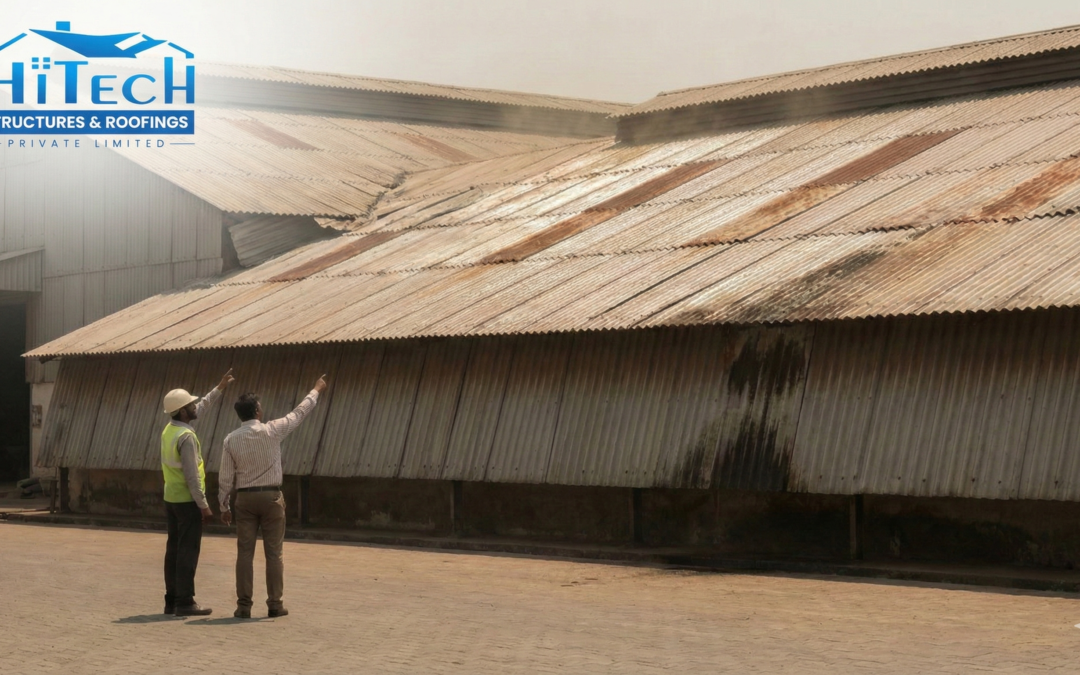
I’ve lost count of how many times a call starts like this: “Sir, roof-la problem irukku… construction mudinju rendu varsham kooda aagala.”……roofing mistakes in Chennai
That sentence alone tells you something is wrong — not with the weather, not with fate, but with decisions made much earlier. In Chennai, roofing failures rarely occur without warning. They’re usually the result of small assumptions made during the planning process. Assumptions like “idhu pothum” or “ellarum idhe dhaan panraanga.”
If you’re building a factory, warehouse, or commercial space here, this is worth reading slowly. Because most roofing mistakes in Chennai don’t look like mistakes at the start, they look practical. Sensible. Cost-saving.
Until they aren’t.
Treating Chennai Like Any Other City
This is where many projects quietly go wrong.
Chennai is harsh on buildings. The heat sits on the roof for hours. Moisture hangs in the air. Salt travels further inland than people expect. But roofing decisions are often copied from projects done elsewhere — sometimes even from another state.
A material that performs decently in a dry climate can struggle here within a few seasons. When corrosion starts early, or the building heats up faster than expected, people are surprised. They shouldn’t be.
The fix isn’t complicated — but it requires accepting that Chennai needs roofing solutions designed for Chennai, not generic ones.
Heat Is Treated as a Comfort Issue, Not a Business Issue
This is a big one.
In industrial buildings, especially, heat is still spoken about as if it’s only about comfort. “Workers adjust pannuvaanga,” or “fan pottaa seri.”
But when the roof transfers heat straight inside, it affects everything — people, machines, storage, even power consumption. We’ve seen factories where electricity bills quietly doubled because the roof was acting like a heating plate.
Once the structure is done, correcting this becomes expensive and messy. That’s why ignoring insulation early is one of the costliest industrial roofing errors we come across.
Decisions Based on Price, Not Performance
Budget matters. Nobody denies that.
But roofing is one place where chasing the lowest number often leads to the highest regret.
Two quotes may look similar on paper, but the differences hide in thickness, coating quality, fasteners, and detailing. These aren’t things that fail immediately. They fail slowly — during the second monsoon, or after continuous summer exposure.
By the time the problem is obvious, the original “saving” is long gone.
A better approach? Ask what the roof is expected to handle over the next 10–15 years, not just what it costs today.
Underestimating Chennai’s Rains (Every Single Time)
It’s strange how often this happens.
Everyone knows Chennai gets heavy rain. Still, drainage is treated like an afterthought. Slight slope miscalculations, undersized gutters, or poor water exit planning lead to water stagnation. And stagnant water always finds a weak point.
Leaks that appear “suddenly” are usually the result of months of slow stress.
Good drainage doesn’t show off. But when it’s missing, the roof makes sure you notice.
Using Residential Logic for Industrial Roofs
This mistake usually shows up when industrial projects are handled by teams more familiar with houses or small buildings.
Large-span roofs behave differently. They move. expand and respond to wind load and internal heat in ways residential roofs don’t. Ignoring this leads to cracks near joints, noise during temperature changes, and structural fatigue.
Industrial roofing needs engineering thinking, not rule-of-thumb execution.
Forgetting That Metal Moves
This sounds basic, but it’s surprisingly common.
Metal expands in heat and contracts when temperatures drop. When allowance isn’t given for this movement, stress builds up quietly. Sheets start warping. Fasteners loosen. Joints fail.
These problems don’t show up in the first year. They show up just late enough to be annoying — and just early enough to feel unfair.
They aren’t unfair. They’re predictable.
Not Thinking Beyond Day-One Usage
Many roofs are designed only for the present requirement. No one asks what might be added later.
Then, two years down the line, solar panels are planned. Or exhaust units. Or cable trays. Suddenly, the roof is being drilled, loaded, and modified in ways it was never designed for.
Good commercial roofing planning includes future questions — even if the answers are vague.
Installation Treated Like a Routine Task
Material quality gets all the attention. Installation is assumed to be straightforward.
It isn’t.
Small things during installation — alignment, sealing pressure, screw placement — decide whether a roof stays silent or becomes a regular maintenance issue. Poor installation doesn’t always fail immediately. It waits.
This is why supervision and experienced teams matter more than speed.
No Thought Given to Maintenance Access
Here’s a practical reality: roofs need inspection.
But many buildings are designed with no safe way to access the roof. No walk paths. anchors. and clear zones. So maintenance is either avoided or done carelessly, leading to further damage.
This is one of those commercial roofing tips people only understand after the first problem appears.
Trusting the Roof Will “Take Care of Itself”
A roof is not a set-and-forget element.
When warranties aren’t discussed clearly, when service responsibility isn’t defined, buildings end up unsupported the moment something goes wrong. And when that happens, even small issues feel big.
A reliable roofing partner doesn’t vanish after installation. That’s not a bonus — that’s basic professionalism.
A Final, Honest Thought
Most roofing mistakes in Chennai aren’t made by careless people. They’re made by smart people who were rushed, under-informed, or advised poorly.
A roof doesn’t shout when it’s done right. It just does its job — season after season.
If you’re planning an industrial or commercial project, slow this decision down. Ask uncomfortable questions. Think long-term. Because once the roof is up, it quietly decides how comfortable, efficient, and stress-free that building will be.
And it remembers every shortcut. knowmore