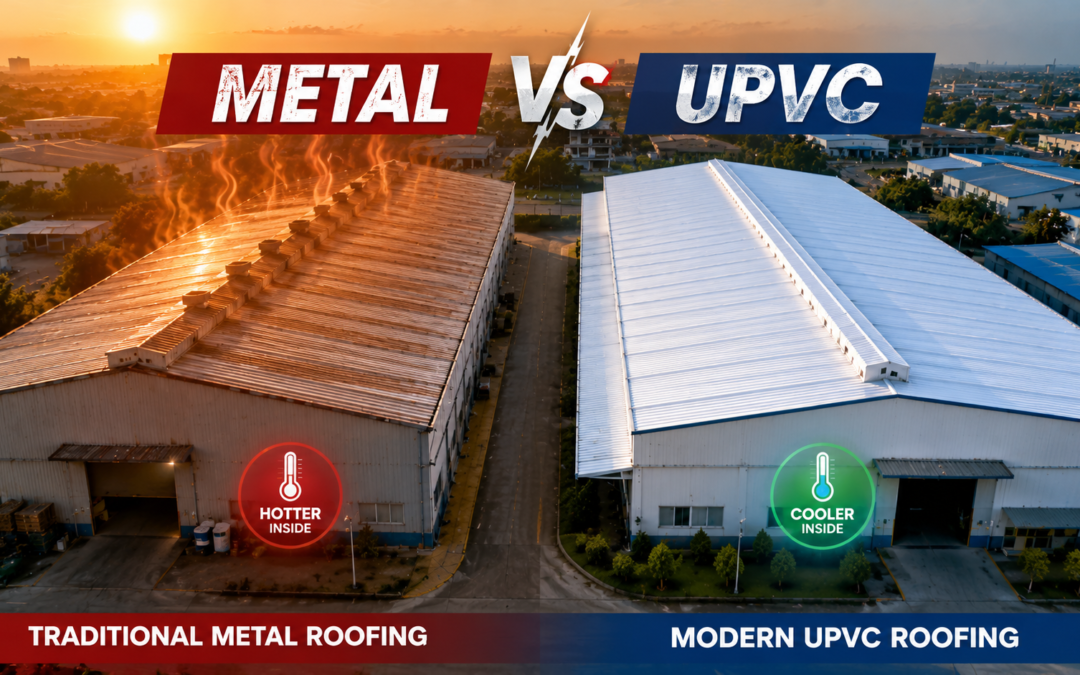
A few years ago, industrial roofing discussions in Chennai were incredibly straightforward. A factory owner would request a few quotations, compare the bottom lines, and almost always sign off on whatever material looked most economical on paper. Today, those conversations look entirely different. The shift isn’t accidental. Electricity tariffs have climbed, summers feel increasingly intense, and workforce retention is directly tied to factory floor conditions. When workers spend long, demanding hours inside industrial sheds, warehouses, and manufacturing units, building owners quickly realize that operating costs matter just as much as initial construction costs. This is exactly why modern businesses are pausing to ask a critical question: UPVC roofing vs metal roofing in Chennai: “Should we stick with traditional metal roofing, or is UPVC roofing actually the smarter investment?”
The answer depends entirely on what you expect from your building over the next 10 to 15 years.
Chennai’s Climate Changes Everything
A roofing material that performs well in a milder climate can fail miserably under Chennai’s unique environmental pressures.
For the vast majority of the year, local roofs endure punishing, direct sunlight. When the monsoon hits, that intense heat gives way to torrential downpours and high humidity. Furthermore, for facilities located near Chennai’s sprawling coastline, salt-laden sea breezes introduce a constant threat of accelerated chemical degradation.
Because of these aggressive localized conditions, choosing a roof isn’t just a standard civil engineering decision; it is a long-term financial strategy. A cheaper material choice today can easily morph into an expensive operational bottleneck tomorrow.
Chennai’s climate presents unique challenges such as extreme summer heat, coastal humidity, heavy monsoon rains, and long-term exposure to corrosive environmental conditions. This is why choosing the best roofing material for Chennai becomes an important long-term decision.
The 2 PM Reality Most Factory Owners Understand
If you have ever stepped onto an industrial floor or into a logistics warehouse during a Chennai summer afternoon, you know exactly what happens. The heat doesn’t stay trapped on the roof’s upper surface; it radiates directly downward.
As internal temperatures climb:
- Machinery runs hotter and requires more frequent maintenance.
- Worker fatigue increases, causing productivity to dip.
- Mechanical ventilation and exhaust systems pull maximum power just to keep air moving.
This is where the debate between UPVC roofing vs metal roofing shifts from technical specifications to real-world business performance. Savvy facility managers are no longer just asking which material boasts a higher tensile strength—they are asking which material keeps their operational costs from skyrocketing.
Why More Businesses Are Looking at UPVC Roofing
Unplasticized Polyvinyl Chloride (UPVC) roofing has rapidly gained market share because it solves the exact pain points that plague Chennai’s industrial corridors.
Unlike conventional corrugated metal sheets, UPVC is entirely immune to rust and chemical corrosion. Furthermore, its inherent material properties offer excellent thermal insulation, significantly slowing down the transfer of solar heat into the building below.
For high-turnover warehouses, manufacturing plants, and commercial facilities, this thermal barrier yields compounding benefits. Factory owners switching to UPVC aren’t necessarily looking for a luxury product—they are looking for a reliable, low-friction solution that guarantees:
- Drastically reduced structural maintenance.
- More manageable indoor ambient temperatures.
- Fewer operational headaches over the building’s lifecycle.
Metal Roofing Still Has Its Place
Acknowledging the benefits of UPVC doesn’t mean traditional metal roofing is obsolete. Metal remains a staple across the Indian industrial sector for good reasons: it is highly accessible, contractors are universally familiar with its installation, and it demands a noticeably lower upfront capital expenditure (CapEx).
| Feature | Traditional Metal Roofing | Modern UPVC Roofing |
| Initial Cost | Lower upfront investment | Moderate to higher upfront investment |
| Corrosion Resistance | Prone to rust (especially in coastal Chennai) | 100% rust and chemical resistant |
| Thermal Insulation | High heat absorption (requires added insulation) | Naturally low heat transfer |
| Acoustic Dampening | Noisy during heavy monsoons | Excellent sound dampening qualities |
For short-term projects, temporary structures, or ventures where initial budget constraints override all other variables, metal roofing remains a highly practical choice. The real challenge simply tends to manifest later, as heat absorption, rust management, and structural repairs begin to alter the true cost of ownership.
The Mistake Most Buyers Make When Comparing Roofing Quotes
When two competing quotations land on a desk, it is human nature to jump straight to the final line item. However, an industrial roof shouldn’t be evaluated the same way you buy office furniture or basic interior finishes.
The smarter metric to track is Total Cost of Ownership (TCO). The material you choose directly dictates:
- The frequency and cost of annual patch repairs.
- The lifespan of internal structural supports.
- Monthly energy bills driven by cooling and ventilation.
- Overall workforce efficiency during peak summer months.
When you look at the math across a decade, these recurring operational expenses frequently dwarf the initial difference between the two material quotes.
Heat Reduction: Where UPVC Gains an Advantage
Excessive indoor heat is arguably the single greatest complaint voiced by factory operations managers in Chennai. While heavy-duty turbo ventilators and under-roof insulation blankets can mitigate the issue, the foundational roofing material sets the baseline.
Metal roofing acts like a thermal conductor. Under direct sunlight, the sheets heat up rapidly and radiate that energy directly into the workspace.
UPVC roofing, conversely, acts as a thermal barrier. Its multi-layer co-extrusion design prevents the bulk of solar heat from penetrating the sheet. For businesses running multi-shift operations throughout the day, this natural thermal resistance creates a safer, more stable working environment and reduces the load on auxiliary cooling systems.
What Happens During Monsoon Season?
Every year, Chennai’s monsoon seasons expose every vulnerability in a commercial layout. Minor installation oversights quickly turn into active leaks, pooling water accelerates rust around fasteners, and high winds test structural integrity.
While an expert installation is required for any roof, the material’s reaction to prolonged moisture is critical. Metal roofing requires vigilant monitoring—especially at overlapping joints and screw penetrations where protective coatings can scratch or wear away. UPVC naturally eliminates this worry because moisture simply cannot induce rust or rot in a polymer matrix, providing immense peace of mind during heavy coastal downpours.
Looking Beyond the First Five Years
Almost any roof looks great and performs adequately during its first 24 months. The true test of value begins around year five.
After enduring multiple punishing summers, cycling through intense monsoon seasons, and constantly fighting Chennai’s humid, salty air, a roof begins to show its true colours. This is precisely where UPVC delivers its return on investment. By eliminating the need for periodic anti-corrosion coatings and reducing leak-related disruptions, it keeps facility management teams focused on production rather than building repairs.
So, Which Roofing Material Is Better?
There is no one-size-fits-all answer.
If your immediate priority is minimizing upfront construction costs or completing a short-term project, metal roofing remains a reliable, industry-standard solution.
However, if you are planning for the next 10 to 20 years and your project priorities include:
- Superior, passive heat management
- Zero rust-related maintenance
- Excellent performance in coastal environments
- Lower overall lifecycle costs
So in UPVC roofing vs metal roofing in Chennai, UPVC roofing represents the more strategic, modern choice for Chennai’s evolving industrial landscape.
Final Thoughts
When weighing UPVC roofing vs metal roofing in Chennai, try to look past the immediate installation invoice. A roof is not a passive cover; it actively dictates how your building performs every day of the year. It impacts your workers’ energy levels, your utility bills, and your maintenance schedules. By focusing on the total value a roofing system delivers across its entire lifespan, you can make a choice that protects both your physical asset and your bottom line.