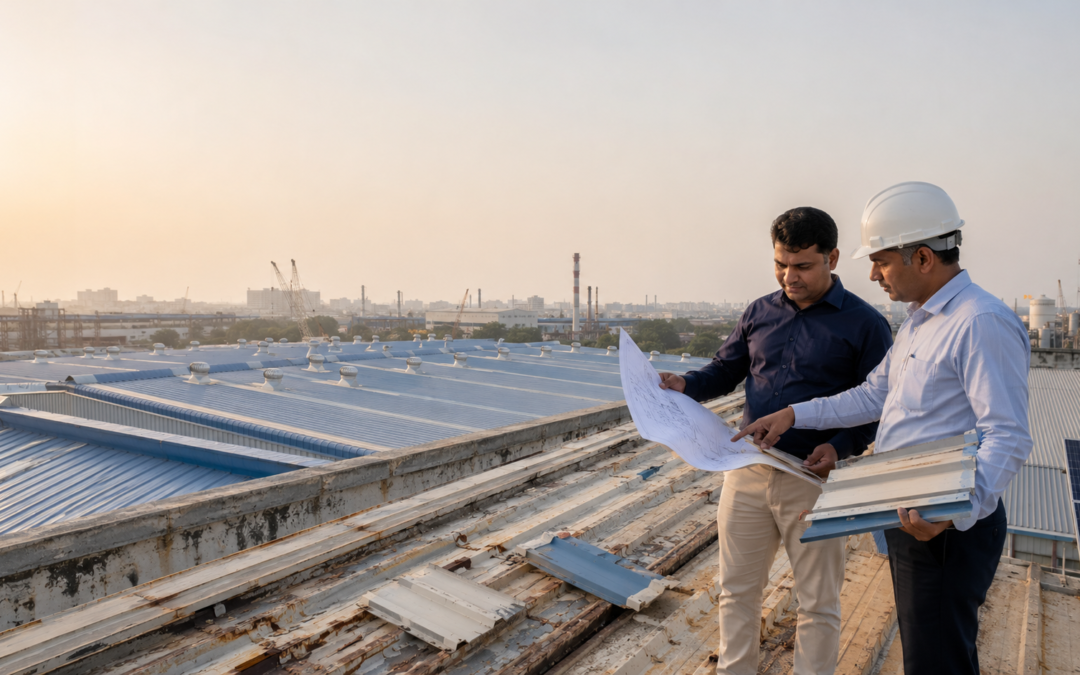
Factory roofing problems rarely begin with a major collapse or visible damage. Let’s see the Industrial Roofing Problems in Chennai.
Most of the time, the warning signs start quietly.
The shed feels hotter than usual during afternoons. Workers begin complaining about trapped heat near production areas. A small leakage appears during heavy rain. Rust develops around fasteners. Maintenance teams keep fixing the same sections repeatedly every few months.
Initially, many factory owners treat these as routine issues.
But over time, these small roofing problems slowly become expensive operational problems.
That’s exactly why understanding industrial shed roofing problems Chennai industries commonly face has become far more important today — especially for warehouses, manufacturing units, and factory buildings exposed to Chennai’s extreme climate conditions.
Because in Chennai, industrial roofing deals with constant pressure from:
- intense summer heat
- coastal humidity
- salt-air exposure
- heavy monsoon rain
- thermal expansion and contraction
And honestly, many industrial roofs begin failing long before businesses expect them to.
In this guide, we’ll break down the most common industrial roofing mistakes factory owners still make in Chennai, why these problems happen repeatedly, and what actually helps improve long-term roofing performance.
Why Industrial Roofing Problems Are Increasing in Chennai
Roofing systems in Chennai age differently compared to many other cities.
Continuous exposure to:
- extreme sunlight
- humidity
- coastal air
- monsoon moisture
creates constant stress on industrial roofing materials.
In older industrial sheds, especially, roofing deterioration usually happens gradually:
- heat buildup increases every summer
- fasteners loosen over time
- Corrosion spreads around joints
- Drainage weakens during the monsoon
- leakage starts appearing in isolated areas
The difficult part is that many of these problems remain unnoticed initially because the building still looks “fine” from the outside.
But internally, the roofing system slowly starts losing performance.
This is one reason many businesses are now investing in modern industrial roofing solutions in Chennai instead of repeatedly patching older roofing systems.
And in reality, repeated repair work often becomes more expensive than planned upgrades.
1. Choosing Roofing Based Only on Lowest Price
This is still one of the biggest mistakes in industrial roofing projects.
Many businesses focus heavily on reducing initial roofing cost during construction or renovation. At first, lower quotations naturally seem attractive.
But roofing problems usually don’t appear immediately.
They begin slowly after repeated exposure to Chennai’s climate conditions.
A few years later, businesses often start dealing with:
- repeated leakage
- excessive indoor heat
- corrosion near fasteners
- sheet deterioration
- repainting costs
- maintenance downtime
In several factory sheds across Chennai, maintenance expenses eventually become far higher than the money initially saved on cheaper roofing materials.
That’s why modern industrial roofing decisions are increasingly based on:
- lifecycle durability
- maintenance reduction
- heat performance
- corrosion resistance
—not just the installation price alone.
Because in industrial environments, cheap roofing often becomes expensive roofing later.
2. Ignoring Heat Build-Up Inside Industrial Sheds
Anyone who has spent time inside a warehouse or factory shed during Chennai’s summer already understands how intense trapped roof heat can become by afternoon.
Especially under ordinary metal roofing.
In many industrial buildings, roofing sheets absorb sunlight continuously throughout the day and slowly radiate that heat inside the structure. By peak afternoon hours, some production areas become noticeably uncomfortable even with fans operating continuously.
This doesn’t only affect comfort.
Over time, excessive indoor heat can also affect:
- worker productivity
- machine efficiency
- storage conditions
- operational performance
Yet many industrial buildings still treat heat reduction as an afterthought instead of a core roofing decision.
That’s exactly why demand for heat-resistant roofing Chennai solutions has increased significantly over the last few years.
Modern systems like:
- UPVC roofing
- insulated roofing
- PUF panel roofing
perform much better in reducing heat transfer compared to conventional roofing sheets.
And in Chennai conditions, the difference becomes noticeable very quickly.
3. Poor Ventilation Planning
This is one of the most underestimated industrial roofing problems.
Many factory sheds install roofing systems without properly planning airflow circulation.
As a result, hot air becomes trapped inside the building throughout the day.
In several warehouse projects across Chennai, excessive indoor heat wasn’t caused only by roofing sheets — poor ventilation was equally responsible.
Common ventilation mistakes include:
- insufficient air outlets
- improper turbine ventilator placement
- blocked airflow pathways
- low roof clearance
- Poor ridge ventilation planning
Without proper ventilation, even premium roofing systems struggle to perform efficiently.
Good warehouse roofing solutions should always combine:
- roofing material selection
- ventilation design
- heat management planning
together.
Not separately.
4. Using the Wrong Roofing Material for Coastal Areas
Chennai’s coastal climate creates a completely different challenge for industrial roofing systems.
Salt-air exposure slowly accelerates corrosion in many conventional roofing materials.
Initially, the damage may appear minor:
- rust near fasteners
- paint fading
- edge corrosion
- discoloration
But over time, corrosion spreads deeper into roofing joints and structural sections.
In several coastal industrial buildings, roofing deterioration becomes visible much earlier than expected because the roofing material itself was not suitable for Chennai’s conditions.
This is one reason more businesses are now moving toward corrosion-resistant roofing materials like UPVC roofing for long-term industrial use.
Choosing a suitable roofing for the Chennai climate is extremely important.
Not every roofing sheet performs the same way in coastal environments.
5. Delaying Minor Leakage Repairs
Most industrial roofing failures begin as small, manageable issues.
A loose fastener.
A weak overlap joint.
Minor leakage during heavy rain.
A drainage blockage near one corner.
Initially, these problems seem harmless.
So businesses postpone repairs.
But during Chennai monsoon seasons, small roofing issues rarely stay small for long.
Water seepage slowly spreads into:
- insulation layers
- structural connections
- electrical systems
- stored inventory
- ceiling sections
And once moisture reaches deeper roofing layers, repair complexity increases significantly.
In many industrial sheds, leakage repair becomes expensive mainly because early warning signs were ignored for too long.
Regular inspection usually prevents major roofing damage later.
Unfortunately, most buildings only receive serious attention after leakage becomes operationally disruptive.
6. Poor Roofing Installation Workmanship
Even high-quality roofing materials fail due to poor installation.
This is something many factory owners realize only after recurring roofing issues begin appearing repeatedly.
Common workmanship problems include:
- weak sheet overlap
- Incorrect fastener spacing
- improper drainage slope
- Rushed sealing work
- uneven installation alignment
Initially, the roof may appear perfectly normal.
But after repeated:
- heat expansion
- monsoon exposure
- wind pressure
- thermal movement
These small installation mistakes gradually start creating leakage and structural stress points.
That’s why choosing an experienced industrial roofing contractor Chennai businesses can trust is just as important as selecting the roofing material itself.
Good roofing performance depends heavily on installation quality.
7. Ignoring Long-Term Roofing Maintenance
One of the biggest reasons industrial roofing systems fail early is a lack of preventive maintenance.
Many factory sheds receive almost no proper inspection after installation.
Over time, this allows small issues to slowly become serious roofing problems.
Industrial roofing systems should be checked periodically for:
- drainage blockage
- corrosion development
- loose fasteners
- sheet displacement
- sealant failure
- structural stress areas
Because Chennai’s climate continuously exposes roofing systems to:
- UV radiation
- humidity
- monsoon moisture
- thermal movement
Without maintenance, roofing deterioration accelerates much faster.
Preventive inspection usually costs far less than large-scale roofing repair or replacement later.
What We Commonly Notice During Industrial Roof Inspections
One pattern appears repeatedly across older industrial sheds in Chennai.
Many businesses continue repairing the same roofing sections again and again without addressing the root problem itself.
In several cases, the actual issue is not just leakage.
It’s:
- trapped heat weakening roofing performance
- poor ventilation
- thermal expansion stress
- corrosion spreading underneath fasteners
- aging roofing materials, losing structural reliability
This is why repeated patchwork repairs often stop working after some time.
Long-term roofing performance depends on solving the underlying roofing system problem — not just the visible symptom.
Best Roofing Solutions for Industrial Sheds in Chennai
There’s no single roofing system suitable for every industrial project.
The right solution depends on:
- operational usage
- heat exposure
- ventilation requirements
- coastal proximity
- maintenance expectations
- structural design
But in Chennai conditions, modern systems like:
- UPVC roofing
- insulated roofing
- PUF panel roofing
generally perform much better for:
- heat reduction
- corrosion resistance
- durability
- maintenance reduction
- long-term lifecycle performance
compared to conventional roofing systems.
That’s why more businesses are now focusing on climate-appropriate roofing instead of simply selecting the lowest quotation.
One Thing Many Factory Owners Realize Too Late
Industrial roofing affects far more than just the building exterior.
Over time, roofing problems slowly impact:
- worker comfort
- maintenance budgets
- warehouse conditions
- operational efficiency
- productivity
- infrastructure lifespan
And once recurring roofing issues begin affecting day-to-day operations, businesses usually realize the roof was never “just a roof.”
It was part of the operational system itself.
That’s why roofing decisions should always be treated as long-term infrastructure investments — not short-term construction expenses.
Frequently Asked Questions About Industrial Roofing Problems
What are the most common industrial shed roofing problems in Chennai?
The most common issues include excessive indoor heat, leakage during monsoon, corrosion, poor ventilation, fastener loosening, and repeated maintenance problems.
Why do factory sheds become extremely hot during summer?
Ordinary metal roofing absorbs and transfers heat rapidly during Chennai summers. Poor ventilation further increases trapped indoor heat.
Which roofing material is best for industrial sheds in Chennai?
Many industrial buildings now prefer UPVC roofing and insulated roofing systems because of better heat resistance, corrosion protection, and lower maintenance.
How can warehouse roofing heat be reduced?
Heat reduction improves through:
- heat-resistant roofing materials
- turbine ventilators
- proper airflow planning
- insulated roofing systems
Why do industrial roofs leak during the monsoon?
Leakage usually develops because of:
- poor installation
- damaged fasteners
- weak drainage
- delayed maintenance
- roofing material deterioration
Is UPVC roofing suitable for factory buildings?
Yes. UPVC roofing performs well for factories and warehouses because of:
- heat resistance
- corrosion protection
- reduced maintenance
- long-term durability
Final Thoughts
In Chennai, industrial roofing should never be treated as just another construction formality.
The wrong roofing system slowly increases:
- indoor heat
- maintenance expenses
- leakage risks
- corrosion issues
- operational discomfort
- long-term repair costs
That’s why more factories, warehouses, and industrial buildings are now investing in roofing systems specifically designed for Chennai’s climate conditions.
Good industrial roofing isn’t only about installation.
It’s about:
- heat management
- ventilation performance
- corrosion resistance
- long-term durability
- lifecycle value
Choosing the right roofing system early usually prevents much larger operational problems later.
Hi-Tech Roofings provides customized industrial roofing solutions across Chennai and Tamil Nadu for factories, warehouses, industrial sheds, and commercial buildings with a focus on heat reduction, weather resistance, long-term durability, and practical industrial performance.